season-guide
How to Evaluate a True Spring Color Direction
Use matched drapes to test Warm or True Spring against Light and Bright Spring, without relying on hair, eye, jewelry, or instant-typing shortcuts.

“True Spring,” also called Warm Spring in EverlySpark’s taxonomy, is most useful as a comparison question: does warmth remain the strongest pattern after lightness and brightness are controlled?
It is not an identity you can confirm from golden hair, clear eyes, peach skin, or a preference for gold jewelry. People with many appearances can respond similarly to color, and cameras, makeup, surroundings, and expectations can all change what you see.
This guide uses EverlySpark’s four observation labels—temperature, value, chroma, and contrast—to organize comparisons. They are an editorial framework, not a scientifically validated diagnostic method. Read the methodology overview for the limits; use this page to distinguish Warm Spring from its two closest Spring neighbors.
The working hypothesis
Warm Spring is a reasonable hypothesis when:
- warm colors are more consistently useful than equally light or equally clear cool colors;
- very light colors lose presence compared with medium-light options;
- extremely bright colors dominate before moderately clear warm colors do;
- muted, gray-heavy colors look less intentional than clean warm colors;
- a medium level of outfit contrast works better than either very soft blending or sharp black-and-white contrast.
None of these observations is proof on its own. The question is whether the pattern holds when you compare like with like.
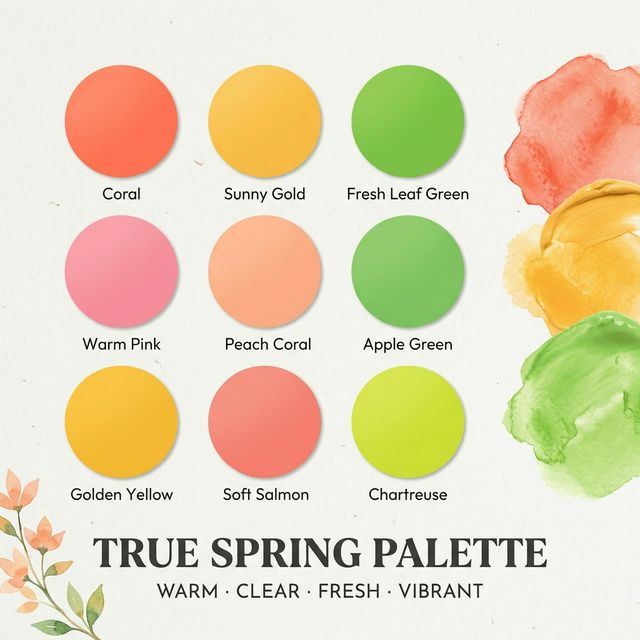
Stage 1: establish a warm direction
Use two or three warm/cool pairs with similar depth and saturation:
| Warm option | Cool option | What stays roughly constant |
|---|---|---|
| tomato red | blue-red | medium value, clear chroma |
| warm turquoise | cool turquoise | medium-light value, similar intensity |
| golden yellow | cool lemon | light-to-medium value, clear chroma |
Compare under the same indirect daylight, from the same camera position if photographing. Remove color-changing filters. Keep makeup and background stable.
Do not ask which color makes you “look warmer.” Ask which produces the more useful styling result: less distracting color cast, a clearer focal point, and less need to compensate with makeup. Those judgments remain subjective, so write down uncertainty rather than forcing a winner.
If cool options repeatedly work better, the Warm Spring hypothesis weakens. If the result is neutral, move to the Spring-neighbor comparisons before making a conclusion.
Stage 2: eliminate Light Spring
Warm Spring and Light Spring can share peach, aqua, coral, and ivory. The difference is not the color name; it is how much lightness the outfit can carry before it becomes faint.
Compare:
- light apricot with medium coral;
- pale warm aqua with medium warm turquoise;
- light camel with medium cognac;
- warm ivory with a slightly deeper cream-beige.
If the lightest versions repeatedly preserve enough structure, use the Light Spring wardrobe test. If medium-light and medium warm colors are more reliable, Warm Spring remains plausible.
Avoid changing value and chroma together. A pale dusty peach versus vivid coral cannot tell you whether the result came from lightness or saturation.
Stage 3: eliminate Bright Spring
Now keep warmth and value close while adjusting chroma:
- dusty coral;
- clean medium coral;
- vivid near-neon coral.
Repeat with warm turquoise or green. The goal is a ladder, not a single “good versus bad” pair.
- If the vivid option repeatedly holds and the medium option feels restrained, compare Bright Spring more closely.
- If the medium clear option works and the vivid one becomes the main event, Warm Spring remains the better working hypothesis.
- If the dusty option is most coherent, investigate a softer warm direction rather than assuming Spring.
The Bright Spring troubleshooting guide helps separate excess chroma from excess contrast.
Contrast as a supporting check
Contrast should not lead this decision. Use it after temperature and chroma.
Create three outfits using the same coral top:
- coral with warm ivory: gentle contrast;
- coral with medium camel: moderate contrast;
- coral with very dark brown: strong contrast.
If moderate contrast repeatedly gives the outfit enough definition without separating the clothing from the face, that supports—but does not prove—the Warm Spring hypothesis.
Evidence that does not settle the question
Jewelry
Gold and silver differ in more than temperature. Finish, reflectivity, size, placement, and surrounding clothing matter. A brushed pale gold and a bright yellow gold are not interchangeable. Use metal as an accessory styling test, not a season diagnosis. See the gold-or-silver decision framework.
Hair, eyes, and skin stereotypes
Warm Spring is not reserved for a specific skin depth, eye color, or natural hair shade. Phenotype descriptions may help imagine a palette, but they cannot determine eligibility.
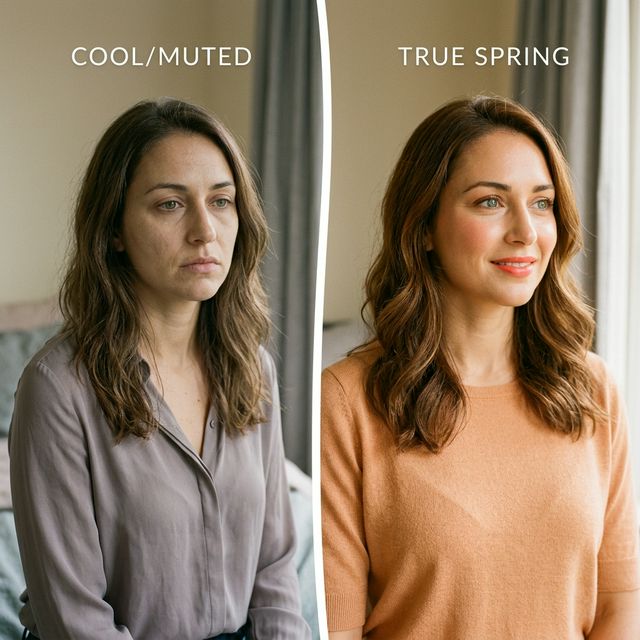
One dramatic photo
Phone white balance and exposure may change between frames. A single image can also capture a different expression or angle. It is an illustration, not a classification result.
Record an uncertain result correctly
Use one of four outcomes after several controlled comparisons:
- Warm direction clearer; Light and Bright both weaker: Warm Spring remains the leading hypothesis.
- Warm direction clearer; lightest colors strongest: compare Light Spring next.
- Warm direction clearer; highest chroma strongest: compare Bright Spring next.
- Results split or change by session: unresolved; improve controls or broaden the comparison.
EverlySpark does not claim that five observations, or any other count, creates validated accuracy. Repeating a pair is simply a guard against treating one impression as certainty.
Turn the hypothesis into a wardrobe action
If Warm Spring is leading, test a three-part near-face capsule:
- a warm medium-light neutral such as cream or camel;
- a clean warm accent such as coral or turquoise;
- a grounding color such as cognac or warm navy.
Wear each in more than one combination. If the palette only works when makeup, lighting, or one exact garment is present, keep the conclusion provisional.
Final takeaway
Do not ask whether you “look like” a True Spring. Ask whether warmth remains useful while very light and extremely bright Spring options become less reliable. Establish temperature first, eliminate Light Spring through value, eliminate Bright Spring through chroma, and use contrast only as supporting evidence.
For the broader map, visit the 12-season guide. If you only have a few minutes today, use the directional triage to choose a next comparison—not to claim a final type.
Not sure which season fits you best?
Start with a simple photo-based personal color analysis, then explore makeup guides and product picks tailored to your results.