season-guide
When Bright Spring Colors Feel Too Strong: A Chroma Test
Separate excess chroma from excess contrast or depth, build a controlled color ladder, and adjust Bright Spring colors without inventing a before-and-after t...

A vivid coral can feel too strong for at least three different reasons: it may be too saturated, too dark, or used in an outfit with too much contrast. Calling all three problems “brightness” leads to the wrong fix.
This guide is a troubleshooting sequence. It assumes Bright Spring is one possibility and asks which variable actually failed. EverlySpark’s temperature, value, chroma, and contrast labels are an observation framework—not a validated diagnostic system—and the images on this page illustrate styling ideas rather than tests EverlySpark performed.
First define “too strong” in a useful way
Skip vague judgments such as “the color wears me.” Record what you can act on:
- the garment becomes the only focal point;
- the edge between garment and face feels unusually abrupt;
- a vivid area looks visually detached from the rest of the outfit;
- makeup has to become stronger to reconnect the look;
- the same hue works when softened, lightened, or reduced in area.
Skin redness, shadows, and texture can change with light, camera processing, sleep, and makeup. Do not treat one frame as proof that a color caused them.
Build a chroma ladder
Choose one hue and keep its value and warmth as close as practical. For coral:
- dusty coral;
- clean coral;
- vivid coral;
- near-neon coral.
Place each color in the same area under the chin. If photographing, lock exposure and white balance when your camera allows it. Keep distance, angle, background, and expression stable.
A useful interpretation is not “step 3 proves Bright Spring.” It is more modest:
- dusty coral looks flat, clean and vivid coral remain coherent: higher chroma may be useful;
- clean coral works but vivid and neon dominate: moderate clarity may be enough;
- every coral result is poor: temperature or hue may be the issue;
- results change across sessions: controls or the hypothesis need more work.
Repeat the ladder with warm turquoise or yellow-green. A pattern across hues is more informative than one favorite color, but repetition is not a validated accuracy threshold.
Do not confuse chroma with value
A pastel can be clear but light. A jewel tone can be clear and deep. If vivid coral is too strong and you switch to dusty burgundy, you reduced chroma and made the color darker.
Use this troubleshooting order:
| What changed? | Better next move |
|---|---|
| Saturation only | Compare dusty, clean, vivid, and neon versions at similar depth. |
| Depth only | Compare light, medium, and deeper versions with similar clarity. |
| Outfit contrast | Keep the vivid top but change the jacket or bottom from near-black to medium value. |
| Visible area | Keep the color but reduce it from a full top to a collar, scarf, or accessory. |
| Temperature | Compare warm coral with cool fuchsia at similar intensity. |
This prevents a common mistake: blaming Bright Spring chroma when the real problem is a deep garment or a black-and-neon outfit.
Contrast can amplify a color that works alone
Try one vivid top in three contexts:
- vivid coral with warm ivory;
- vivid coral with medium camel;
- vivid coral with black.
The hue has not changed, but the outfit’s edge contrast has. If coral works with ivory and camel but becomes disconnected with black, the first adjustment is the supporting neutral—not necessarily the coral.
Bright Spring can use contrast, but “more contrast” is not automatically better. Compare the whole outfit rather than inferring contrast tolerance from dark hair, light skin, or eye color.
Four practical fixes
Reduce saturation, not energy
Move from neon coral to clean coral or from electric lime to fresh leaf green. The color can remain lively without becoming fluorescent.
Reduce area
Use a vivid shade as a narrow neckline, earring, bag, shoe, or print accent. Distance and area can change the effect more than a season label does.
Add a bridge color
Place warm ivory, camel, or a medium warm neutral between the face and a very vivid or dark item. This lowers the abrupt edge without removing the statement color.
Change texture
Gloss, sequins, and metallic fabric increase reflected intensity. A matte or textured version of the same hue may be easier to integrate.
What the comparison image can—and cannot—show
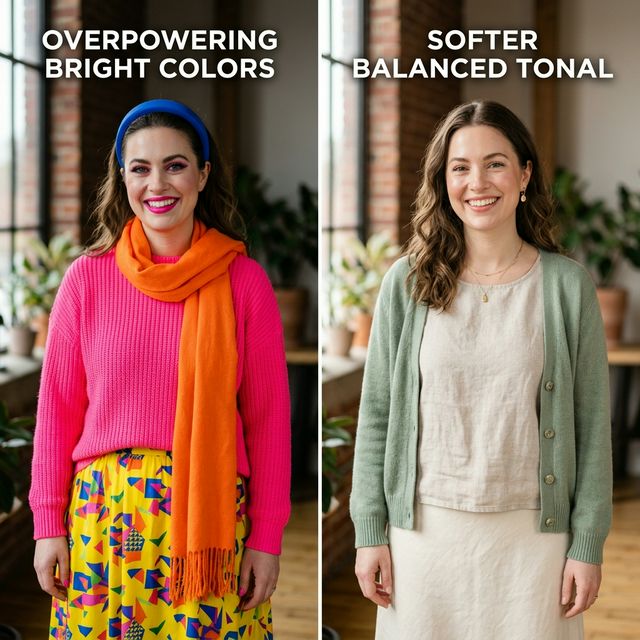
The image is an editorial illustration. It should not be read as proof that changing one color produced the pictured skin or facial changes. Generated or staged images cannot establish a personal color result because lighting, rendering, expression, and image processing are not controlled evidence.
Use real fabrics on the same person if you want to compare. Even then, describe the procedure as a suggested observation exercise—not an experiment EverlySpark carried out.
Where to look if brightness is not the problem
- If cool vivid colors are better than warm vivid colors, compare Bright Winter and Bright Spring.
- If warm colors work but the lightest versions are best, test Light Spring.
- If moderate clear warm colors win and neon does not, evaluate Warm/True Spring.
- If softer warm colors are consistently better, use the Light Spring versus softer warm comparison without treating “Soft Spring” as a universally standardized 12-season label.
A wardrobe decision, not a verdict
Pick one difficult vivid garment and make three photographs:
- full near-face area with a dark neutral;
- full near-face area with a medium-light neutral;
- small accent area with the same medium-light neutral.
If the second or third setup is more coherent, you have a styling solution. You have not proved or disproved a season.
Final takeaway
When Bright Spring colors feel overpowering, isolate the source. Test a chroma ladder, then check value, contrast, visible area, temperature, and texture. Change one variable at a time. The most useful result may be “vivid coral works in a smaller area,” not “I am—or am not—Bright Spring.”
For a site-wide explanation of the observation framework and its limits, read the science and limits of seasonal color analysis. If you want only a quick next step, use the five-minute directional triage.
Not sure which season fits you best?
Start with a simple photo-based personal color analysis, then explore makeup guides and product picks tailored to your results.