guide
Gold or Silver Jewelry? A Metal, Finish, and Contrast Test
Compare gold, silver, mixed metals, shine, scale, and wardrobe fit with a controlled daylight test and a transparent 12-season starting matrix.
Gold versus silver is not a binary undertone test. A polished yellow-gold hoop, brushed pale-gold stud, oxidized silver pendant, and mirror-bright silver chain change several variables at once: temperature, shine, depth, scale, and reflected surroundings.
The useful question is: which combination works for your face, wardrobe, and intended level of contrast?
Quick decision
- Compare metals of similar size and shine in neutral daylight.
- Test near the face, where reflected color and contrast are most visible.
- Record temperature, finish, depth, and scale separately.
- Repeat against two outfits you actually wear.
- If neither metal wins consistently, choose mixed metal or let wardrobe compatibility lead.
A personal color season supplies a starting hypothesis. It does not make one metal forbidden.
Metal comparison matrix
| Variable | Details |
|---|---|
| Temperature | One direction: yellow/rose/bronze; Other direction: silver/white-metal/gunmetal; What to watch: Does the metal look integrated or noticeably yellow/icy? |
| Finish | One direction: brushed/matte/antique; Other direction: polished/mirror; What to watch: Does shine support the face or become the first focal point? |
| Depth | One direction: pale gold/light silver; Other direction: bronze/oxidized silver/gunmetal; What to watch: Does the piece need more or less visual weight? |
| Scale | One direction: fine/small; Other direction: broad/statement; What to watch: Does size, rather than metal color, create the mismatch? |
| Placement | One direction: wrist/below neckline; Other direction: earrings/hairline/short necklace; What to watch: Does the result change when reflection moves closer to the face? |
| Wardrobe | One direction: warm earths/cream; Other direction: black/cool gray/optic white; What to watch: Does the metal connect to the clothing even if it is not the “season default”? |
12-season starting hypotheses
| Season | Details |
|---|---|
| Light Spring | First metal to compare: pale yellow or light rose gold; Finish/weight to test: fine, gently polished; Important counter-test: light silver of equal scale |
| True Spring | First metal to compare: clear yellow gold; Finish/weight to test: clean polish, medium-light; Important counter-test: bright silver, not oxidized silver |
| Bright Spring | First metal to compare: bright gold or mixed metal; Finish/weight to test: higher polish/contrast; Important counter-test: bright silver with warm clothing |
| Light Summer | First metal to compare: light silver or white metal; Finish/weight to test: fine, soft polish; Important counter-test: pale rose gold |
| True/Cool Summer | First metal to compare: silver/white gold direction; Finish/weight to test: satin to polished; Important counter-test: avoid comparing only against dark antique gold |
| Soft Summer | First metal to compare: brushed silver; Finish/weight to test: low-to-medium shine; Important counter-test: muted rose or mixed metal |
| Soft Autumn | First metal to compare: brushed/antique warm gold; Finish/weight to test: low shine, medium scale; Important counter-test: brushed silver against actual wardrobe |
| True Autumn | First metal to compare: yellow gold or bronze; Finish/weight to test: textured/rich; Important counter-test: clean silver of similar depth |
| Deep Autumn | First metal to compare: bronze or deeper gold; Finish/weight to test: substantial/antique; Important counter-test: gunmetal or deep silver |
| Deep Winter | First metal to compare: gunmetal, silver, or white metal; Finish/weight to test: deeper visual weight; Important counter-test: antique gold with dark wardrobe |
| True/Cool Winter | First metal to compare: silver/white-metal direction; Finish/weight to test: crisp polish; Important counter-test: clear yellow gold, same scale |
| Bright Winter | First metal to compare: bright silver or mixed high-polish metal; Finish/weight to test: strong clarity; Important counter-test: equally polished bright gold |
This table is EverlySpark styling analysis. It is not a physiological or scientific result, and boundary cases may reverse the starting order.
Why finish can matter more than metal family
Soft palettes may reject mirror shine while tolerating the nominally “wrong” metal in a brushed finish. Bright palettes may tolerate both gold and silver when the finish is clear and the piece has enough contrast. Deep palettes may need visual weight that a fine pale chain does not provide.
Test finish before concluding that undertone alone caused the result.
The controlled daylight test
Most jewelry tests are uncontrolled. A yellow bathroom bulb advantages gold; one tiny stud compared with a large silver hoop tests size more than temperature.
Use this protocol:
- Choose two pieces with similar size, placement, and shine.
- Stand in indirect daylight against a neutral background.
- Remove other colored jewelry from the comparison area.
- Alternate the pieces near one side of the face.
- Ask whether the face or the metal becomes the dominant focal point.
- Repeat with one lower-shine pair.
- Check the winner with a common warm outfit and a common cool outfit.
Do not treat gray or orange reflections in one photograph as a medical sign. Camera white balance, walls, and fabric can cast color.
If both metals work
That is a useful result, not a failed test.
Choose by:
- wardrobe hardware—buckles, bag chains, watch, glasses;
- maintenance and durability requirements;
- allergies and material specifications;
- contrast level and finish;
- emotional or cultural significance.
Mixed metal can bridge a wardrobe with both warm and cool neutrals. No unsupported percentage is required: repeat one metal in two visible places and use the other as a deliberate accent.
If neither works
Change one variable:
- polished to brushed;
- bright yellow gold to pale gold or bronze;
- bright silver to pewter or gunmetal;
- large hoop to small stud;
- short necklace to a lower placement;
- solid metal field to a mixed or stone-separated design.
A “wrong metal” may actually be a scale, shine, depth, or placement problem.
How hair, tanning, and makeup should be handled
Hair color, tanning, and makeup change the visible comparison context. They do not prove that a permanent season has changed.
Retest after a major change, but describe the result narrowly: this finish works better with the current hair color is more defensible than platinum hair made the undertone cool.
For hair accessories, the metal is judged against a much larger hair background. That is a distinct problem covered in Hair Jewelry: Choose Metal by Hair Contrast and Placement.
Evidence and methodology boundary
Color appearance is contextual, a principle discussed in Chevreul’s historical work and modern perception research. Those sources do not provide a validated gold-versus-silver rule for twelve personal color seasons.
This page’s matrices and decision tree are EverlySpark’s transparent styling synthesis using the same temperature, value, chroma, and contrast framework explained in What Is Personal Color Analysis?. See the seasonal-color evidence map for what is supported and what remains convention.
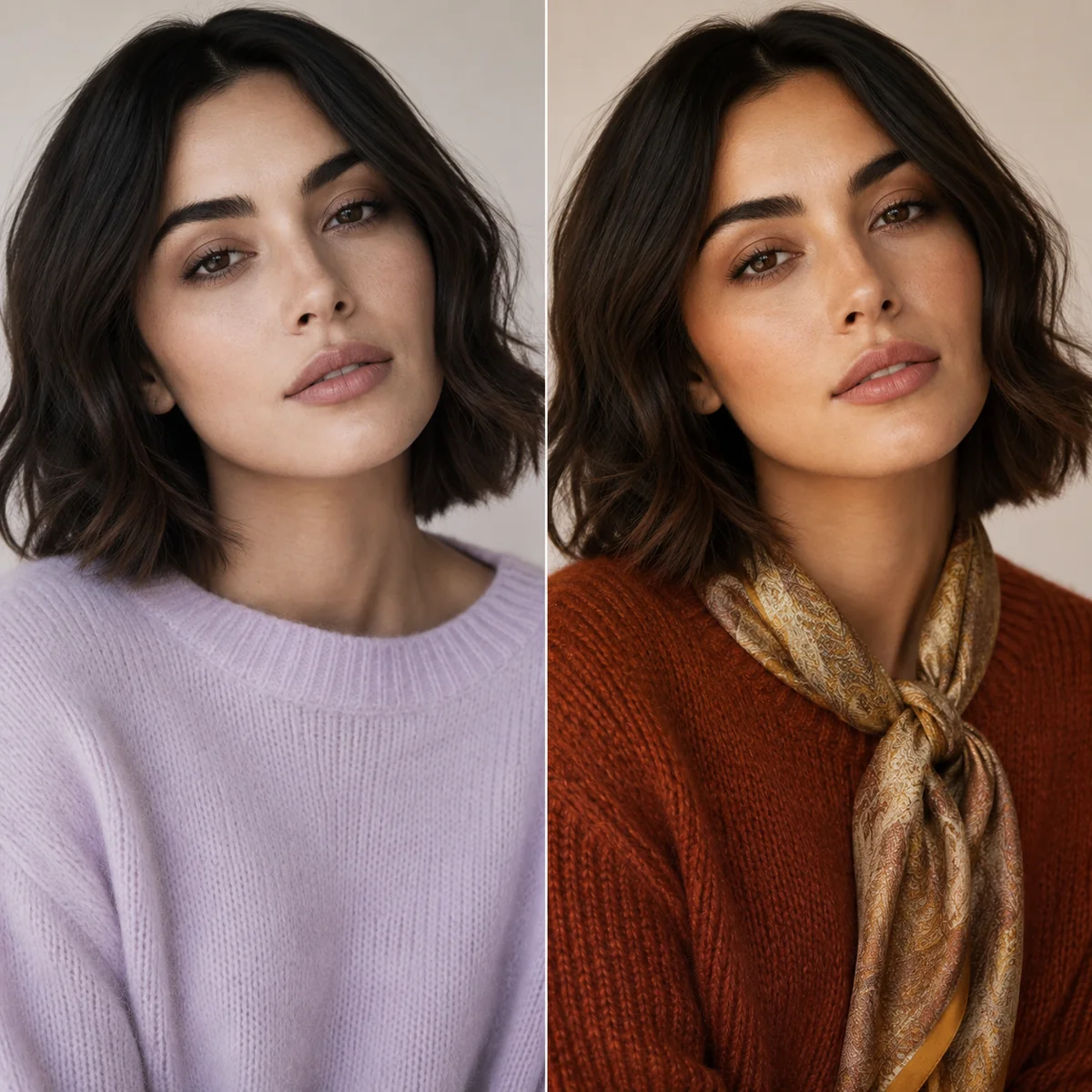
Images are illustrations, not before-and-after tests.
Sources
- Michel Eugène Chevreul, The Laws of Contrast of Colour, historical source for contextual color relationships; not jewelry or seasonal validation.
- David I. Perrett and Richard Sprengelmeyer, “Clothing Aesthetics: Consistent Colour Choices to Match Fair and Tanned Skin Tones,” i-Perception 12(6), 2021; relevant context research, not a metal rule.
Sources and links checked September 7, 2026.
Bottom line
Start with the metal family suggested by your broad temperature direction, then actively test the opposite metal at matched scale and shine. Let finish, visual weight, placement, wardrobe, and material requirements overrule a simplistic gold/silver binary.
Not sure which season fits you best?
Start with a simple photo-based personal color analysis, then explore makeup guides and product picks tailored to your results.