season-guide
Why a Color Can Wash Out Soft Summer—and How to Adjust It
Diagnose temperature, depth, saturation, contrast, and placement separately so a difficult Soft Summer color becomes a solvable styling problem.

“Washed out” is a symptom, not a color category. A Soft Summer outfit can feel weak because the color is too warm, too dark, too saturated, too pale, too high-contrast, or simply placed in the wrong area. A universal avoid list hides the cause.
This page is a repair manual for a Soft Summer working hypothesis. EverlySpark uses temperature, value, chroma, and contrast to organize observations; it does not present those labels as a validated diagnosis. The general worst-color guide explains cross-season mismatch. Here, each Soft Summer failure mode gets a test and an adjustment.
Failure mode 1: the color is warmer, not merely brighter
Mustard, orange, and warm coral are often placed on Soft Summer avoid lists. The useful question is whether temperature caused the problem.
Compare near-equal versions:
- muted coral vs dusty rose;
- warm taupe vs cool taupe;
- olive vs softened blue-green;
- warm burgundy vs cool berry.
Keep depth and saturation close. If the cool option repeatedly creates the more coherent near-face result, temperature may be the variable. If both work, do not invent a warm/cool certainty.
Salvage move: keep the warm item below the waist, reduce its visible area, or add a cool gray, soft navy, or dusty rose layer near the face.
Failure mode 2: saturation is louder than the outfit
Neon pink and electric blue differ from Soft Summer colors mainly in chroma, but they often arrive with extra contrast and glossy fabric too.
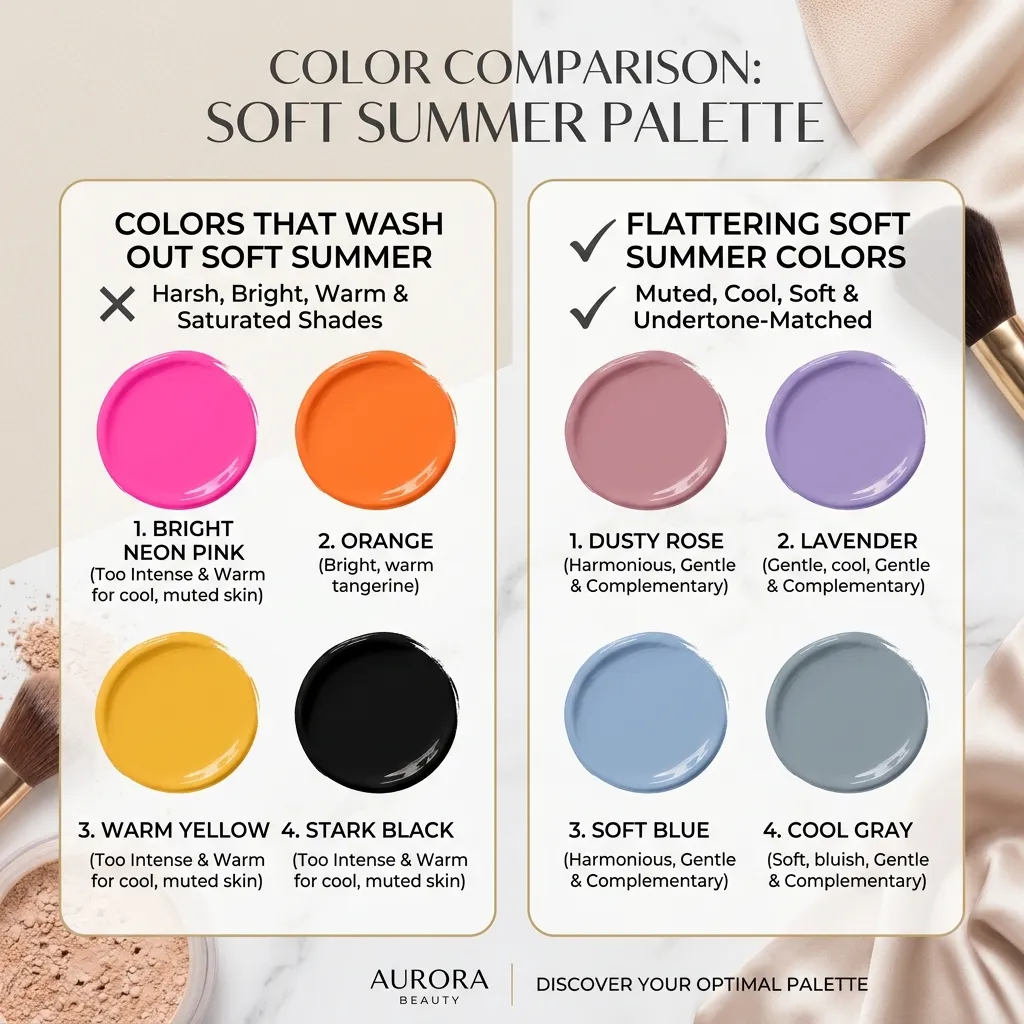
Build a saturation ladder at similar value:
- grayed blue;
- soft clear blue;
- vivid blue;
- electric blue.
If step 2 works better than both the grayest and the brightest options, “muted” does not mean “as gray as possible.” Soft Summer styling still needs enough color to avoid looking faded.
Salvage move: choose a matte version, reduce the vivid area, or pair it with a medium-value soft neutral instead of black or optic white.
Failure mode 3: depth creates a hard edge
Jet black, espresso, and very deep navy can add more value contrast than a Soft Summer outfit needs. But “dark” is not automatically wrong.
Compare charcoal, soft navy, and black in the same neckline. If charcoal and soft navy provide structure while black becomes visually separate, the issue is depth or contrast rather than hue.
Salvage move: replace the near-face dark with charcoal or softened navy. Keep black in footwear, trousers, a narrow print, or a bag.
Failure mode 4: a pale color removes too much structure
Stark white is often blamed for being too bright, while very pale gray or pink may be called safe. Yet an extremely pale, low-chroma color can also make an outfit feel unfinished.
Compare pale gray, medium dove gray, and soft navy. If medium value gives the face and garment a clearer relationship, the solution is more depth, not more muting.
Salvage move: add a medium-value collar, scarf, jacket, or lip color rather than abandoning the pale garment.
Failure mode 5: the combination is the problem
A black-and-white outfit creates a different effect from the same white worn with dove gray. A vivid berry top feels different with black trousers than with soft navy.
Test the supporting colors:
| If the outfit feels… | Change one thing |
|---|---|
| too sharp | Replace black/white with charcoal/soft white. |
| too flat | Add one medium-depth berry, blue, or plum accent. |
| too warm | Move the warm color away from the face or add a cool bridge. |
| too gray | Introduce a cleaner version of one existing hue. |
| too busy | Repeat fewer colors and reduce the number of value jumps. |
Soft Summer often benefits from connected value steps, but tonal dressing is an option—not a rule.
Failure mode 6: placement exaggerates a small mismatch
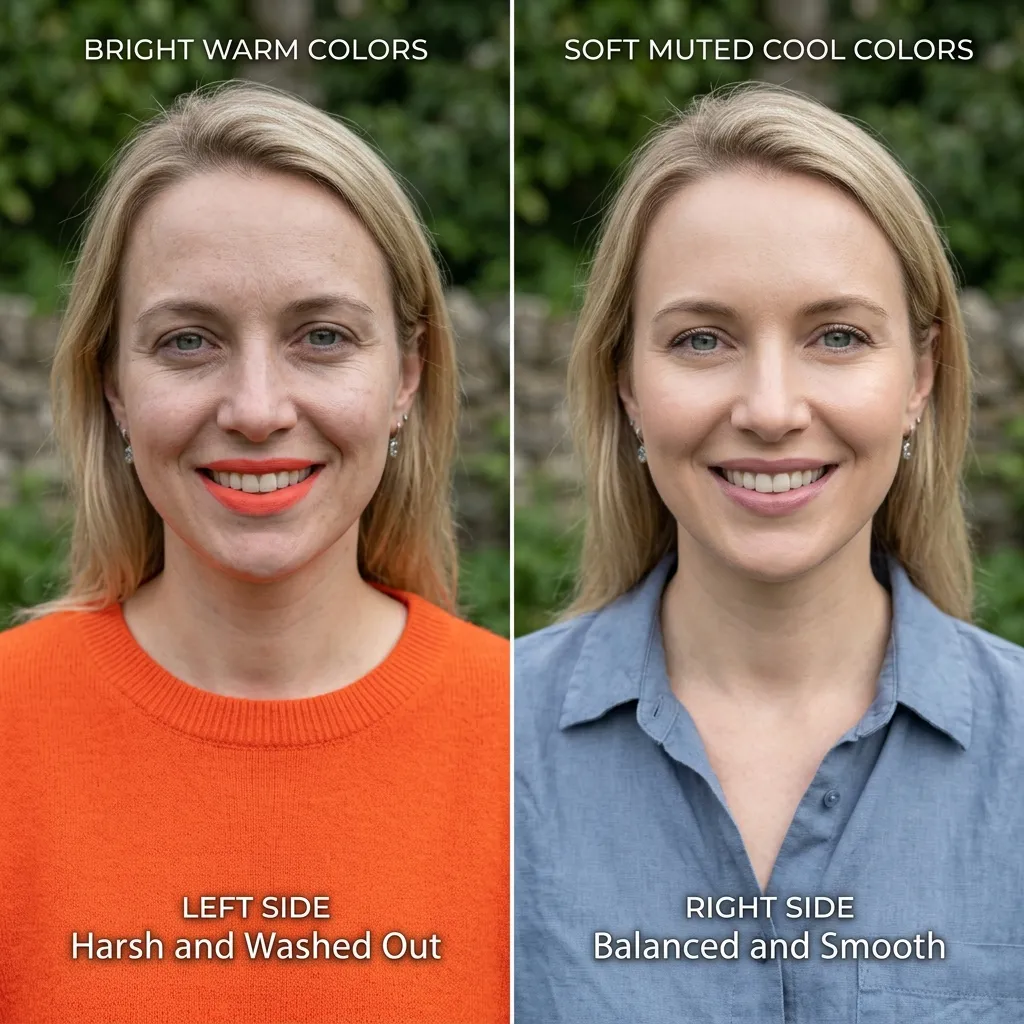
The same orange is more influential as a turtleneck than as a shoe. The same bright white is more noticeable in a broad collar than in a narrow stripe.
Before replacing a garment:
- open the neckline;
- add a scarf or collar in a more useful near-face color;
- move the color into a lower layer;
- reduce the area with an open jacket;
- repeat it in a smaller accessory so it reads as intentional.
Placement is especially valuable when a color matters for uniform, cultural, team, or personal reasons.
A one-garment troubleshooting worksheet
Choose one item you avoid wearing.
- Name the observable problem: loud edge, dull field, warm cast, lack of structure, or disconnected outfit.
- Identify the likely variable: temperature, value, chroma, contrast, or placement.
- Find one comparison item that changes only that variable as closely as possible.
- Photograph both in the same indirect daylight with stable camera settings.
- Try one salvage move.
- Record whether the adjustment was useful, slight, or unresolved.
This is a proposed comparison routine. It is not an experiment EverlySpark claims to have conducted, and no fixed number of repeats guarantees accuracy.
When Soft Summer may be the wrong hypothesis
Reconsider rather than stretching the label if:
- warm muted colors repeatedly work as well as or better than cool muted colors;
- clear cool colors consistently outperform softened ones;
- deep colors are more reliable than medium values;
- high-contrast combinations give structure without looking separate;
- outcomes depend more on fabric, makeup, or lighting than on the proposed palette.
If warmth is the unresolved variable, use the Soft Summer versus Soft Autumn comparison. If coolness is clear but subtype is not, compare Soft Summer and Cool Summer.
Final takeaway
Do not ban a hue because one version “washed you out.” Identify whether the problem was temperature, value, chroma, contrast, or placement. Then change one variable and retest. The result should be a better outfit decision—even if your season stays unresolved.
For a broad palette map, use best colors for each season. For a quick next comparison rather than a final label, use the five-minute directional triage.
Not sure which season fits you best?
Start with a simple photo-based personal color analysis, then explore makeup guides and product picks tailored to your results.