season-guide
Soft Summer vs Soft Autumn: How to Tell the Difference
Intro
If you are drawn to muted, soft colors but feel unsure whether cool or warm tones suit you better, you may be choosing between Soft Summer and Soft Autumn. These two palettes are often confused because they share the same level of softness — but their undertones create very different effects on your appearance.
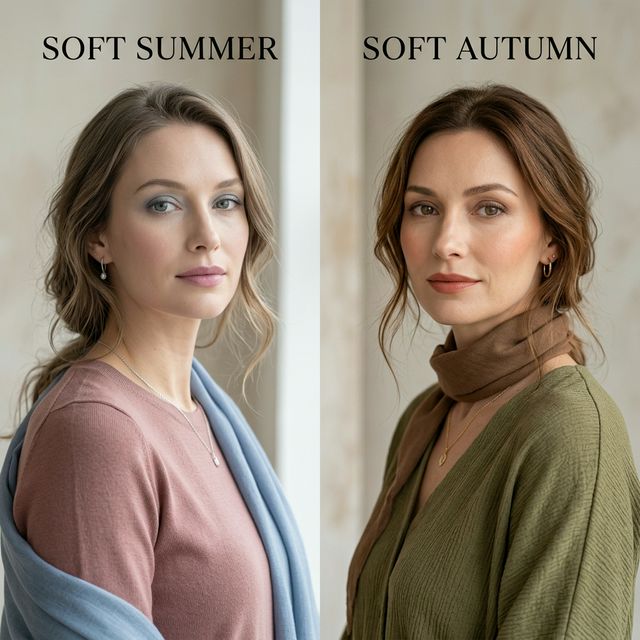
In this guide, you’ll learn how to tell the difference between Soft Summer and Soft Autumn, what makes each palette unique, and how to identify which one truly enhances your natural features.
What Soft Summer and Soft Autumn Have in Common
Both Soft Summer and Soft Autumn belong to the muted side of the personal color spectrum. This means:
- Colors are soft and blended rather than bright
- High-contrast or vivid shades tend to feel overwhelming
- Your features likely appear gentle rather than sharp
Because both palettes share this softness, it’s easy to confuse them. The key difference lies in undertone — cool vs warm.
Soft Summer: Cool, Muted, and Elegant
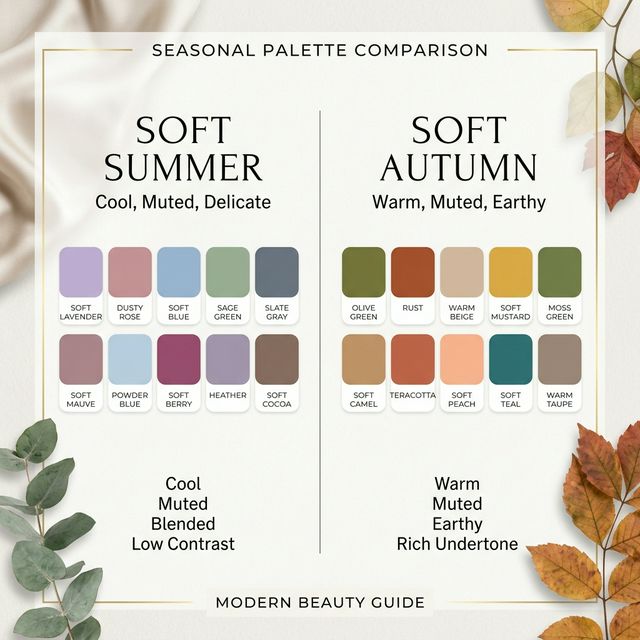
Soft Summer is defined by cool undertones combined with low saturation. The colors are slightly grayish and refined.
Typical Soft Summer colors include:
- Dusty rose
- Lavender
- Soft blue
- Cool gray
- Muted berry
These colors create a calm, sophisticated, and harmonious effect.
Soft Summer works best if:
- Your skin has a cool or neutral-cool undertone
- Cool tones make your complexion look smoother
- Warm tones feel slightly heavy or yellow
Soft Autumn: Warm, Muted, and Earthy
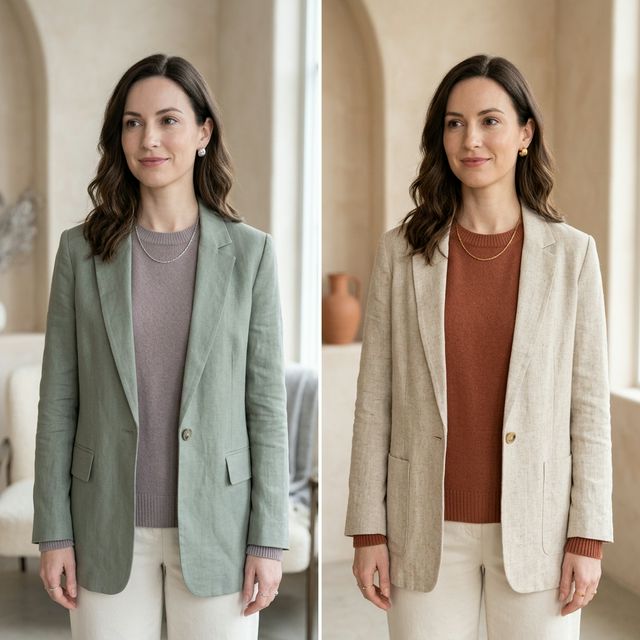
Soft Autumn is warm but still muted. The colors are soft, earthy, and slightly golden.
Typical Soft Autumn colors include:
- Olive green
- Warm beige
- Soft rust
- Muted coral
- Warm taupe
These tones create a natural, grounded, and warm appearance.
Soft Autumn works best if:
- Your skin has a warm or neutral-warm undertone
- Warm tones make your skin look more alive
- Cool tones make you look slightly dull
The Key Difference: Cool vs Warm Softness
The simplest way to tell the difference is to observe how your skin reacts to temperature.
- If cool muted tones (lavender, dusty rose) make your skin look clearer → Soft Summer
- If warm muted tones (olive, beige) make your skin glow → Soft Autumn
Even though both palettes are soft, the undertone completely changes the effect.
How to Test It Yourself
Try this simple test in natural daylight:
- Hold a cool muted color (like dusty rose) near your face
- Then switch to a warm muted color (like olive or warm beige)
Look closely at your reflection:
- Does your skin look smoother and more even with the cool tone?
- Or does the warm tone make your complexion look healthier and more radiant?
Your answer will point you toward your correct palette.
Common Mistakes
One of the most common mistakes is focusing only on softness and ignoring undertone. While both palettes are muted, temperature is the deciding factor.
Another mistake is assuming that neutral colors automatically suit everyone. Even neutral shades can lean warm or cool.
What Happens If You Choose the Wrong One?
Wearing the wrong palette can subtly affect your appearance:
- Cool tones on a Soft Autumn may look dull or lifeless
- Warm tones on a Soft Summer may appear too heavy
- Your natural harmony may be lost
These differences may seem subtle, but they significantly impact your overall look.
Final Thoughts
Soft Summer and Soft Autumn share a similar softness, but their undertones create completely different results. One enhances cool elegance, while the other highlights warm, natural depth.
Understanding this difference allows you to choose colors that work with your natural features instead of against them.
👉 Find Your True Season
Still unsure whether you are Soft Summer or Soft Autumn?
Try a personalized color analysis to discover the tones that make you look your best — instantly.
Common Mistakes to Avoid
- Avoid overly bright neon shades.
- Avoid warm orange-coral tones when your season is cool.
- Avoid high-contrast finishes that overpower soft coloring.
Not sure which season fits you best?
Start with a simple photo-based personal color analysis, then explore makeup guides and product picks tailored to your results.