season-guide
Worst Colors for Each Season: Diagnose the Mismatch and Fix It
Instead of banning colors, identify whether temperature, value, chroma, contrast, placement, or finish is causing the mismatch—and rescue the outfit.
There are no universally bad colors. There are colors whose temperature, value, chroma, contrast, placement, or finish create a poor tradeoff in a specific outfit.
A list that says “Spring cannot wear gray” is not very useful. Warm dove gray may work; dark blue-gray may not. A gray trouser is also a different problem from a gray turtleneck covering the entire area below the face.
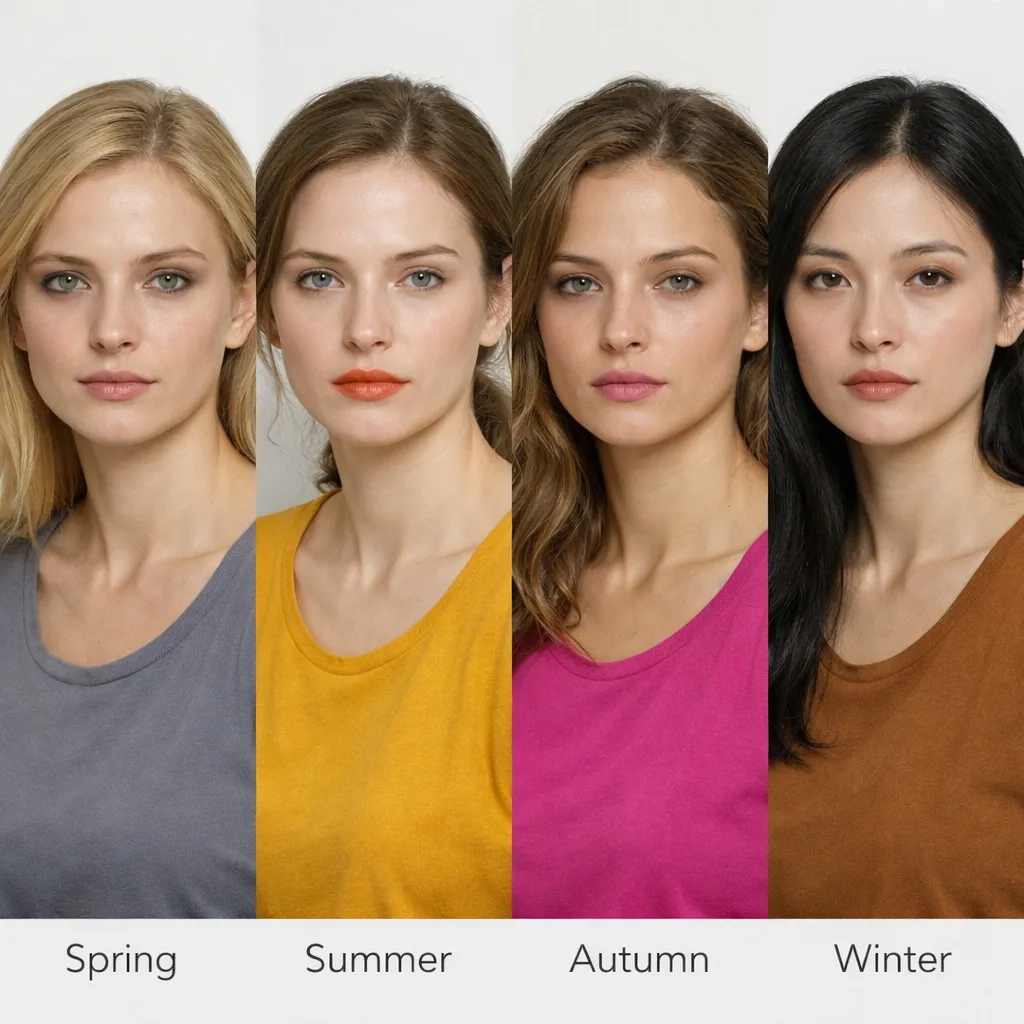
Use mismatch, not prohibition
EverlySpark’s shared method uses four color axes:
- Temperature: warm versus cool
- Value: light versus deep
- Chroma: soft versus clear
- Contrast: low versus high combinations
The companion best-colors matrix shows starting color families. This page starts where the palette fails: what changed, and what is the least expensive fix?
Symptom → likely mismatch → lower-cost fix
| What you observe in a stable comparison | Details |
|---|---|
| The garment arrives visually before the face | Likely variable: Chroma or contrast is too high; Test before rejecting the color: Try a grayer version at the same temperature; Lower-cost outfit fix: Reduce near-face area; add a softer collar, scarf, or layer |
| The face seems to recede or lose definition | Likely variable: Chroma/contrast may be too low; Test before rejecting the color: Try a clearer version without changing depth; Lower-cost outfit fix: Add a crisp trim, frame, lipstick, or higher-contrast neckline |
| The color feels yellow/orange beside the face | Likely variable: Temperature may be too warm; Test before rejecting the color: Compare a cooler version of the same hue; Lower-cost outfit fix: Separate it with a neutral near-face layer |
| The color feels icy or detached | Likely variable: Temperature may be too cool; Test before rejecting the color: Compare a warmer version at similar value; Lower-cost outfit fix: Add a warmer metal, print, or neckline color |
| The outfit feels heavy from the neck up | Likely variable: Value is too deep or coverage is too large; Test before rejecting the color: Try one or two steps lighter; Lower-cost outfit fix: Move the color to bottoms, shoes, or a smaller accessory |
| A pale color looks chalky or unfinished | Likely variable: Value is too light or contrast too low; Test before rejecting the color: Test a deeper related shade; Lower-cost outfit fix: Add a deeper jacket, hair accessory, or frame |
| The shade works in one room but not another | Likely variable: Lighting or finish is unstable; Test before rejecting the color: Repeat in indirect daylight and intended lighting; Lower-cost outfit fix: Avoid a high-stakes purchase until the result repeats |
These are observational hypotheses, not medical claims about skin. A single photograph can exaggerate or reverse them through white balance and exposure.
Four parent-season risk patterns
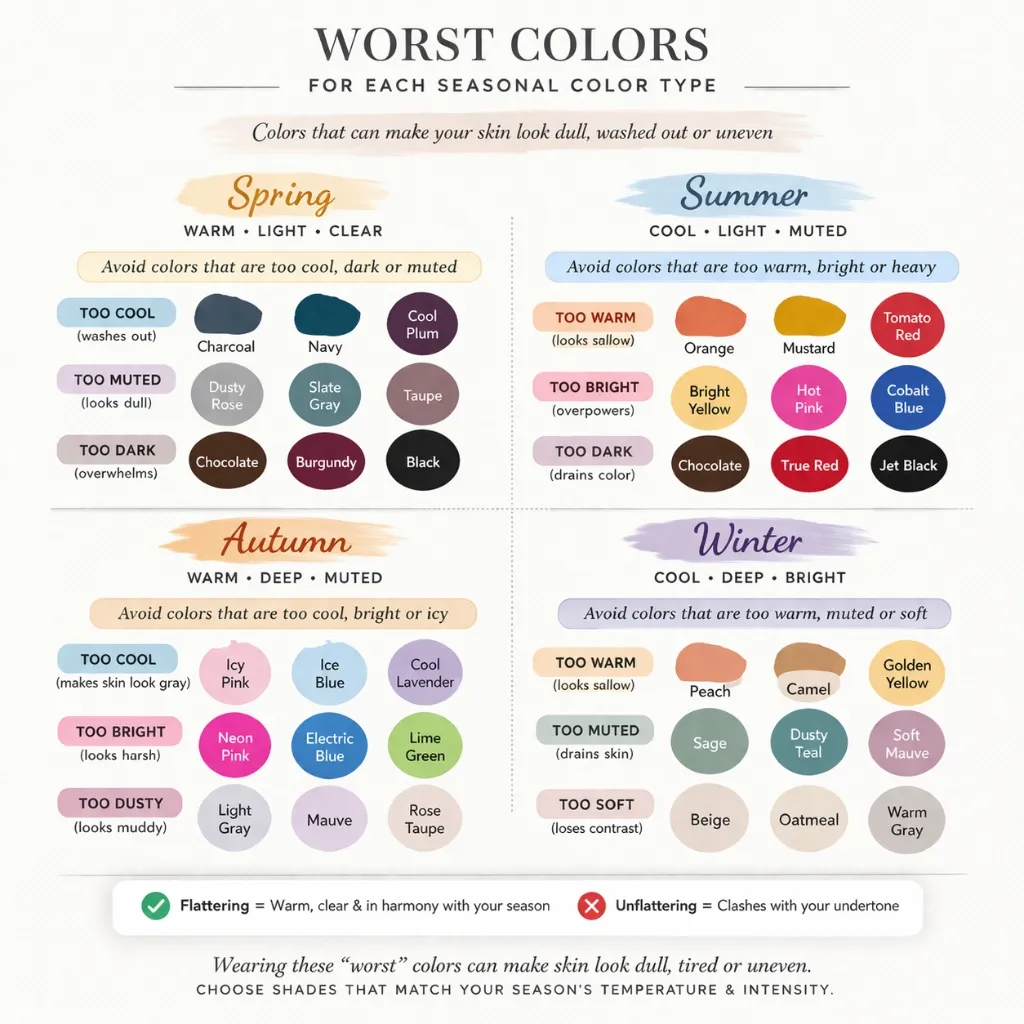
Spring: the risk is usually heaviness or grayness
Spring starts warm and clear, with Light, True, and Bright variants. Instead of banning all black, gray, or cool blue, ask which variable is causing the problem.
- Light Spring: very deep colors may dominate because value is the main constraint.
- True Spring: cool or gray-heavy versions may interrupt the warm-clear direction.
- Bright Spring: heavily muted colors can look flat even when their temperature is warm.
Rescue: keep a difficult dark color below the waist, break it with cream or warm aqua near the face, or choose a clearer warm gray rather than dusty blue-gray.
Summer: the risk is usually heat or aggressive saturation
Summer starts cool and softer, but Light Summer and Soft Summer need different fixes.
- Light Summer: depth may fail before warmth does.
- True/Cool Summer: a strongly yellowed orange or brown may be the obvious mismatch.
- Soft Summer: neon or high-shine color can become the focal point.
Rescue: cool a warm hue, lower the saturation, or reduce its surface area. A rust skirt can stay while a slate, rose, or soft-navy top controls the near-face field.
Autumn: the risk is usually iciness or insufficient weight
Autumn starts warm and soft/rich. It is not limited to brown.
- Soft Autumn: clear brights may feel disconnected.
- True Autumn: icy blue or blue-white may create the strongest temperature conflict.
- Deep Autumn: very pale, delicate color may lack enough visual weight.
Rescue: warm an icy color toward teal or cream, use textured rather than optical-white fabric, or anchor a pale top with a deep warm jacket.
Winter: the risk is usually mud or weak contrast
Winter starts cool and clear, often carrying stronger contrast.
- Deep Winter: pale dusty colors may not provide enough depth.
- True/Cool Winter: warmth can be more disruptive than darkness.
- Bright Winter: muted colors may lose the clarity that supports the palette.
Rescue: sharpen the contrast with black, white, cool navy, or a clear accent; move camel or muted beige away from the face; choose a cooler, cleaner version of the hue.
The same “bad” color can fail for different reasons
Beige is a useful example:
- on Bright Winter it may be too muted and too low-contrast;
- on True Winter it may also be too warm;
- on Light Spring it may work if it is light, warm, and clean;
- on Soft Autumn it may work if it has enough warmth and controlled softness;
- on Deep Autumn it may be fine as a background but too weak as the only near-face color.
Without naming the variable, “avoid beige” teaches nothing transferable.
Placement changes the result
A color covers different visual territory depending on the item:
- Largest effect: turtleneck, scarf, hijab, glasses, hair color, large earrings.
- Medium effect: collared shirt, jacket, necklace, hat.
- Smaller near-face effect: narrow trim, small studs, watch.
- Low near-face effect: trousers, skirt, shoes, bag.
If a favorite color is difficult, first reduce its near-face area. This is usually cheaper than replacing the item.
Finish changes chroma and contrast
A printed swatch does not predict every material.
- Satin and polished metal reflect more light and may read clearer or higher contrast.
- Brushed metal, suede, heathered knit, and washed denim soften an otherwise strong color.
- Sheer fabric lets skin or underlayers influence the result.
- A small print can average visually into a softer field; a large geometric print can increase contrast.
The season label is therefore only the starting hypothesis. Surface and scale can rescue—or disrupt—the same nominal hue.
A five-minute rescue protocol
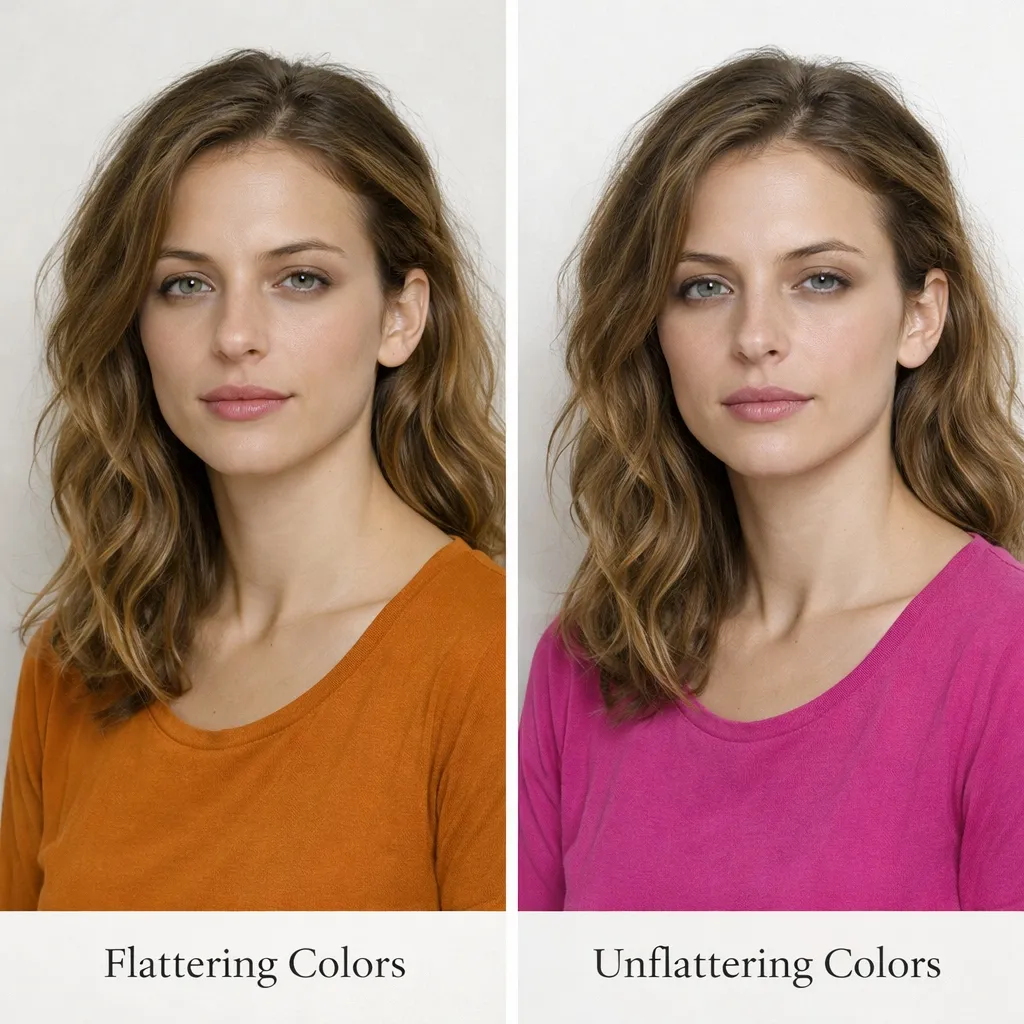
- Photograph the item near the face in indirect daylight.
- Compare a similar item that changes only one axis.
- Name the likely mismatch: warmer/cooler, lighter/deeper, softer/clearer, or lower/higher contrast.
- Test one intervention: layer, placement, finish, or scale.
- Keep the item if the fix works in the setting where you will wear it.
If the result changes with every photograph, the test is not controlled enough to justify a purchase or a purge. Review the personal color methodology and limitations before assigning more labels.
When to ignore the palette
Ignore the recommendation when:
- a uniform or cultural garment carries more important meaning;
- comfort, sun protection, safety, or fit is the real requirement;
- the intended creative effect is deliberate contrast or disharmony;
- personal preference outweighs a subtle visual difference;
- the comparison is too unstable to support a confident conclusion.
A seasonal palette is a decision aid, not permission.
Methodology note
This diagnostic table is EverlySpark editorial analysis built from the temperature, value, chroma, and contrast framework defined in our foundational guides. The underlying idea that context affects color appearance has scientific support; the season-specific rescue rules are styling hypotheses, not clinical findings. See our evidence map for the boundary.
FAQ
What is the worst color for each season?
There is no single worst hue. Spring most often struggles with excessive heaviness or grayness; Summer with warmth or hard saturation; Autumn with iciness or insufficient depth; Winter with muddiness or weak contrast. The subtype and material decide the exact version.
Can I wear black outside Winter?
Yes. Reduce its near-face area, soften the finish, or pair it with a supporting collar, scarf, jewelry metal, or makeup color. Light seasons may also prefer charcoal, navy, or brown-black.
Should I throw out colors outside my palette?
No. Test placement and pairing first. Bottoms, shoes, bags, prints, and layered outfits can keep a difficult color without making it the main field around the face.
Not sure which season fits you best?
Start with a simple photo-based personal color analysis, then explore makeup guides and product picks tailored to your results.