season-guide
When Warm Colors Can Work for True Winter
Replace absolute warm-color rules with matched comparisons, near-neutral exceptions, and placement strategies for a Cool or True Winter wardrobe.
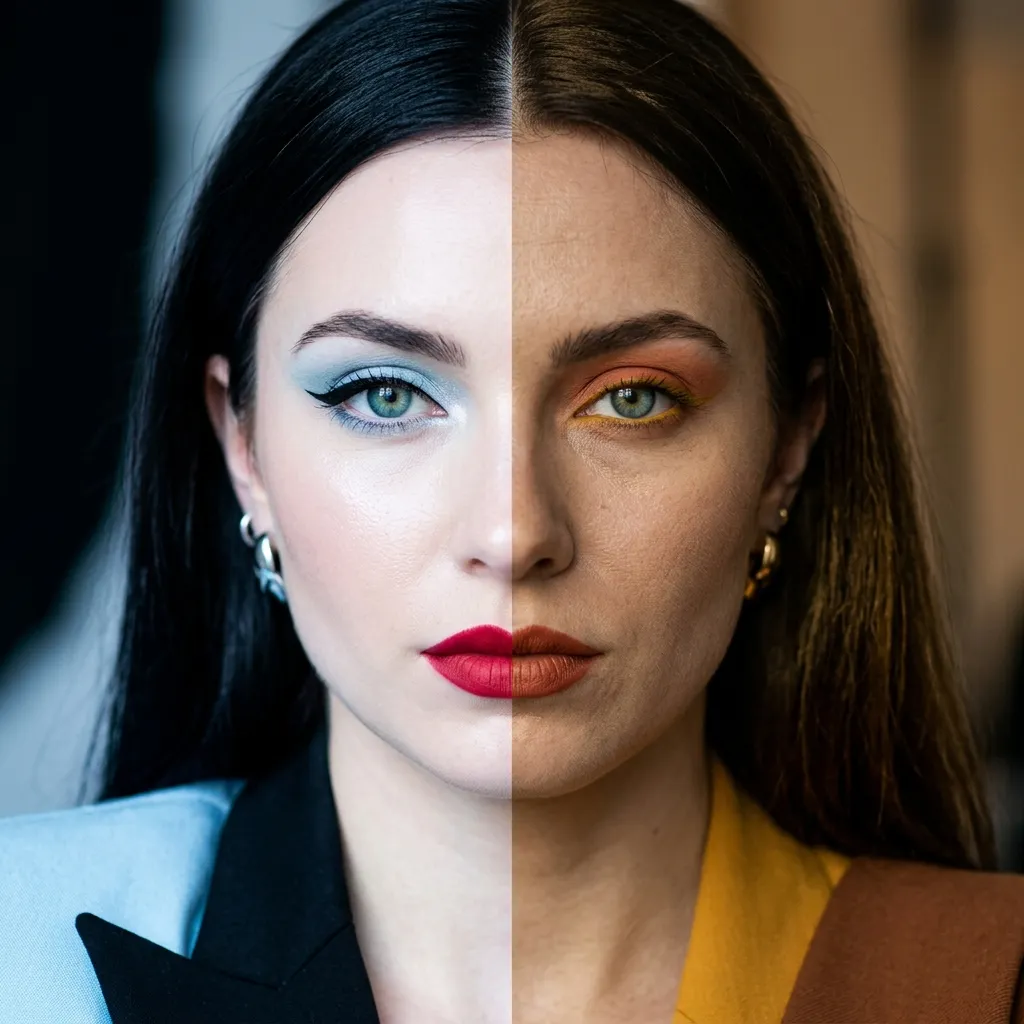
Warm colors are not automatically forbidden for True Winter. “Warm” covers a large range: yellow-orange mustard, near-neutral red, dark olive, and warm beige behave differently in value, chroma, contrast, and placement.
Within EverlySpark’s 12-season vocabulary, True Winter aligns with the Cool Winter direction. The practical question is: when a warm-looking color is useful, which other properties are compensating—and how can you style it intentionally?
Temperature, value, chroma, and contrast are EverlySpark’s observation framework, not a validated diagnostic method. This page assumes Cool/True Winter is a working palette and focuses on exceptions, not on proving the season.
Why the absolute rule fails
A sentence such as “cool colors always work and warm colors never work” ignores:
- near-neutral hues: reds, greens, and browns can sit close to the warm/cool boundary;
- value: a deep warm color may preserve needed structure better than a pale cool color;
- chroma: a clear warm red may be easier than a dusty cool mauve;
- contrast: the supporting neutral can make or break the outfit;
- placement: a warm turtleneck and a warm shoe have different influence;
- material: shine, texture, and translucency alter the visible result.
The title of this article now reflects that nuance. It no longer claims a universal ban.
Build a useful comparison
Choose a warm favorite and a cool neighbor at similar depth and saturation:
| Warm-looking option | Cooler comparison | Keep similar |
|---|---|---|
| tomato red | blue-red | clear chroma and medium depth |
| warm burgundy | cool berry | deep value and finish |
| dark olive | cool pine | depth and saturation |
| camel | cool taupe | medium value and texture |
Use the same indirect daylight, fabric area, makeup state, camera settings, and background. Record whether the difference is clear, slight, or unresolved.
The aim is not to prove that “warm is bad.” It is to learn whether moving the hue cooler improves the outfit while the other variables stay stable.
Exception 1: near-neutral temperature
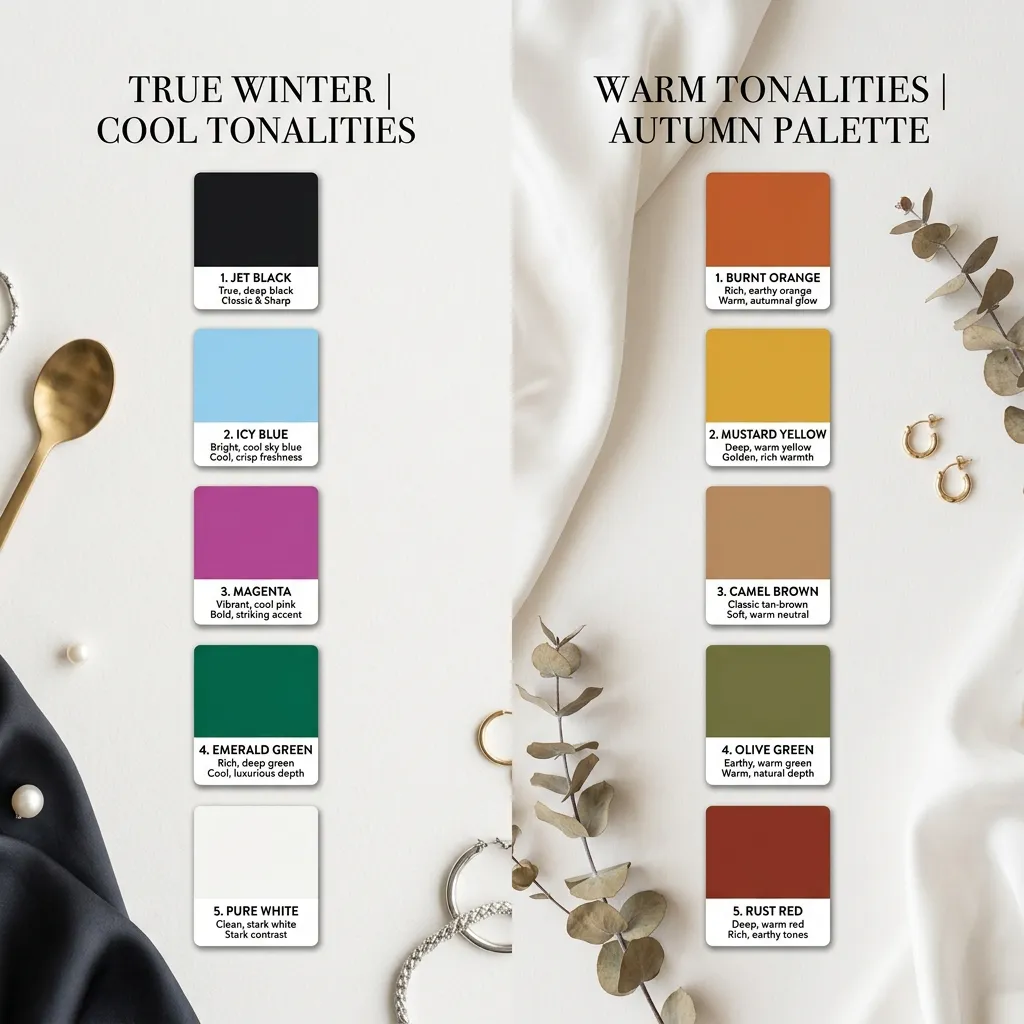
A balanced red may read warm in one context and neutral in another. Deep teal, pine, aubergine, and burgundy can also sit close enough to the boundary that value and clarity dominate the outfit.
If a warm-looking color repeatedly works, compare its actual neighbor before assuming it disproves the Winter hypothesis. The difference may be smaller than the color name suggests.
Action: place two versions side by side. If both are useful, keep both and record temperature as unresolved for that hue family.
Exception 2: clear chroma carries the color
Cool/True Winter palettes are commonly modeled with clear color. A clean warm red can therefore be more useful than a grayed cool rose, because chroma changed more than temperature.
Action: compare clean warm red, clean cool red, and muted cool red. If both clean reds beat the muted one, clarity may matter more than the warm/cool distinction in that test.
Exception 3: deep value preserves structure
A dark warm burgundy or olive may provide enough depth to support a Winter-style outfit. A pale cool beige may not.
Action: hold depth steady before judging temperature. Compare dark olive with cool pine—not dark olive with icy blue.
Exception 4: contrast can bridge a warm accent
A warm accent may become coherent when repeated in a small print and framed by a cool dark neutral.
Try:
- warm red accent + navy + crisp white;
- olive bag + charcoal outfit;
- camel trouser + cool berry or cobalt top;
- yellow-gold detail + black or navy, with a cooler metal elsewhere if desired.
This does not make the warm color “cool.” It changes its area and relationship to the rest of the outfit.
Exception 5: distance from the face
Near-face color has more influence on the visible field around the face. Move a challenging warm color to trousers, footwear, a bag, or a narrow trim before removing it from the wardrobe.
If the item must stay near the face, add a cool collar, scarf, jacket lapel, or neckline layer.
Diagnose the actual failure
| What you observe | Test next |
|---|---|
| Mustard looks dull but tomato red works | Compare chroma and depth; do not blame warmth alone. |
| Camel feels weak | Try deeper cognac or move camel below the waist. |
| Warm burgundy works at night but not daylight | Repeat under stable light; material or context may be changing the result. |
| Black works but cool pastels do not | Depth/contrast may matter more than temperature in that comparison. |
| Cool and warm reds both work | Preserve a near-neutral red range rather than forcing a binary rule. |
Do not use a single exception to type yourself
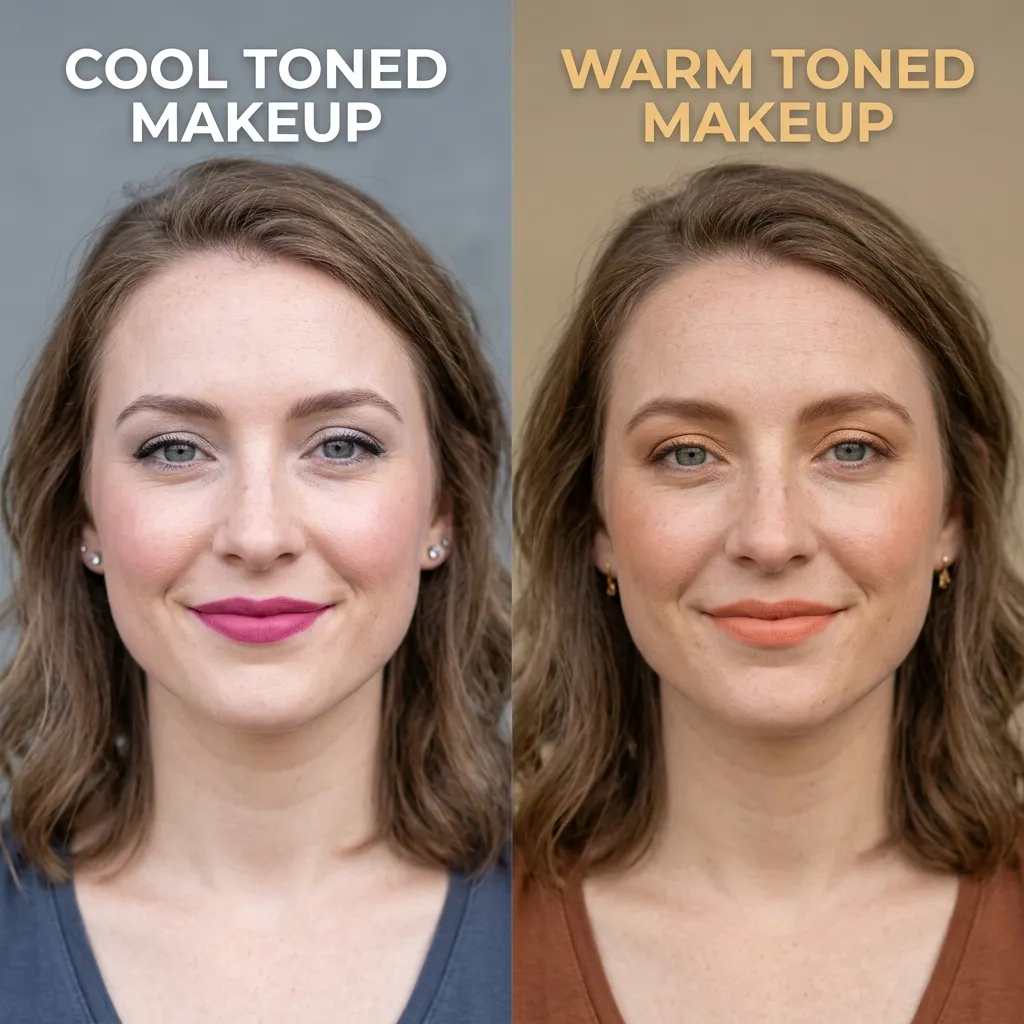
A useful warm color does not disprove True Winter, just as a useful black garment does not prove it. A season model is a summary of tendencies across comparisons, not a permission system.
If clear warm colors repeatedly outperform equally clear cool colors, compare Bright Winter and Bright Spring. If deep warm colors repeatedly outperform matched cool ones, compare Deep Winter and Deep Autumn.
No specific number of repeated observations guarantees accuracy. Repetition simply helps expose unstable lighting or one-off preferences.
Final takeaway
True Winter does not require banning every warm color. Compare warm favorites with close cool neighbors, then account for depth, clarity, contrast, material, area, and distance from the face. Near-neutral or deep clear warm colors may be workable even when cooler versions are usually easier.
For the broader method and its limits, read the science behind seasonal color analysis. For general alternatives to severe black, see why black does not look the same on everyone.
Not sure which season fits you best?
Start with a simple photo-based personal color analysis, then explore makeup guides and product picks tailored to your results.